Piercing Materials
On this page, you will find information about the materials we use for our piercings and why we choose them.


Materials
Safety and quality comes first
The quality of a piercing is determined not only by the piercing technique itself, but also by the material of the jewelry. For this reason, we exclusively use high-quality materials that are suitable for long-term contact with the body and meet the highest standards within the professional piercing industry.
Implant grade titanium
Most piercings are performed using implant-grade titanium of medical quality.
We only use:
- Ti-6Al-4V-ELI (ASTM-F136 / ISO 5832-3)
- Ti-6Al-7Nb (ASTM-F1295 / ISO 5832-11)
These materials are widely used in medical implants around the world and are known for their excellent biocompatibility, durability, and comfort when worn.
All titanium jewelry we use complies with the legal requirements for initial piercings as set out in Annex XVII of the European REACH Regulation, as well as the guidelines established by the Association of Professional Piercers (APP).
Solid gold
In addition to titanium, many piercings can be performed with solid 14k or 18k gold ends from the initial piercing appointment, allowing for a more luxurious aesthetic without compromising safety or quality.
We exclusively use jewelry that is suitable for fresh piercings and complies with ASTM F-2923 and ASTM F-2999 standards. This allows you to choose a more luxurious look from the start without compromising on safety or quality.
Why do we use bars/posts instead of rings?
For nearly all fresh piercings, we choose either a straight or curved bar as the initial jewelry.
A post/bar:
- Gives less friction during healing
- Minimizes pressure
- Promotes a smooth healing process
- Minimizes chances of irritation
Exceptions include septum, daith, and certain genital piercings, for which a different style of jewelry is anatomically more appropriate.
After healing a bar can be switched to a ring.
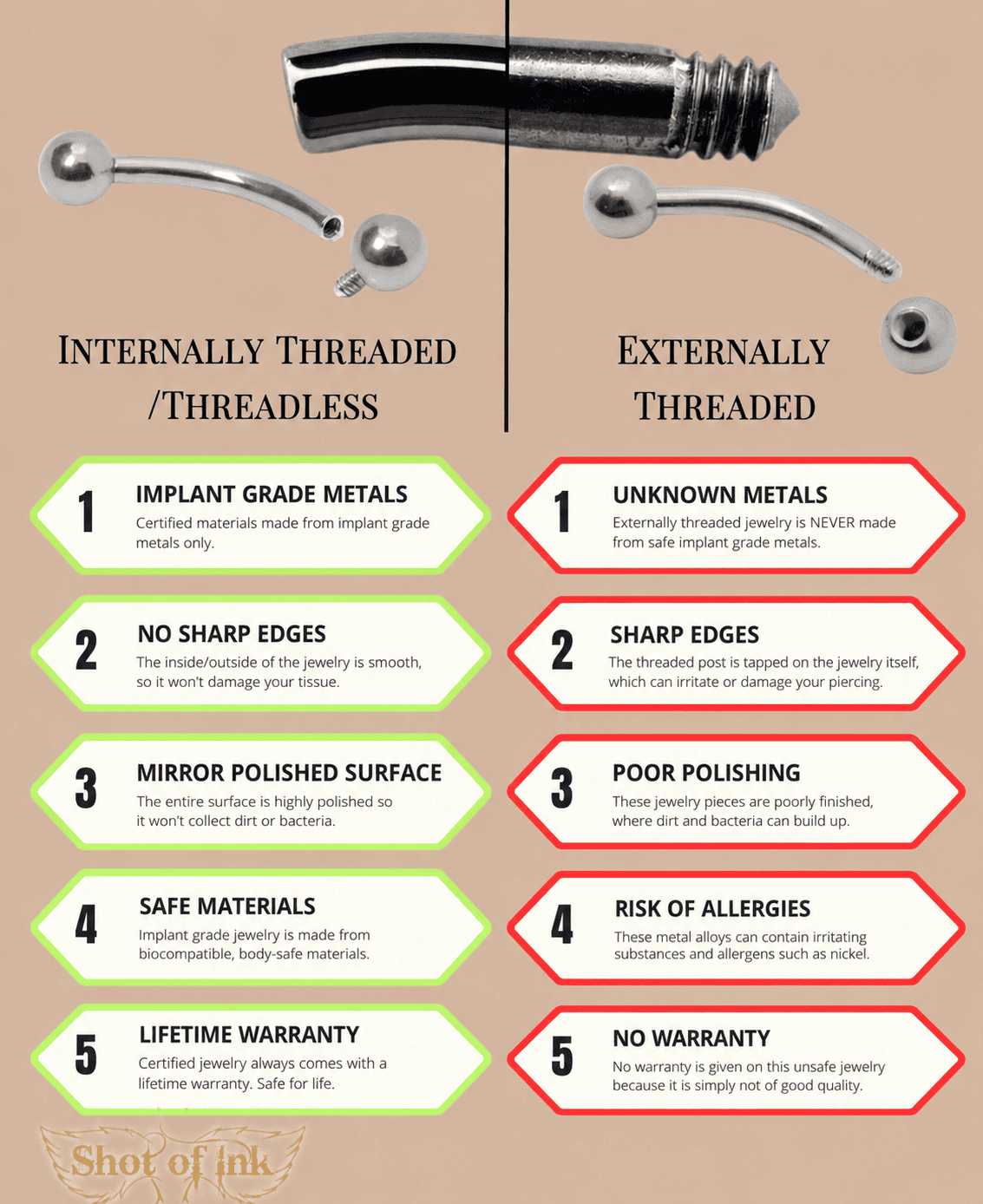
Threadless or internally threaded
We exclusively work with threadless or internally threaded jewelry.
With these systems, no external threading is present on the wearable portion of the jewelry. This helps prevent damage to the healing piercing channel during jewelry insertion or replacement.
The importance of surface finish
The surface finish plays a big part in the healing process.
Our implant-grade titanium jewellery is produced with the utmost care and complies with DFARS (Defense Federal Acquisition Regulation Supplement). Each piece is hand-polished and inspected to ensure a mirror-smooth finish, helping to prevent micro-imperfections that could cause irritation or allow bacteria to settle.
A smooth surface:
- Gives less irritation
- Prevents friction
- Makes it harder for bacteria to settle
- Promotes optimal wound healing
Quality is in the details
Low-quality jewelry from unverified sources often features external threading, poor surface finishing, and metal alloys whose composition cannot be verified.
A quality piece of jewelry has:
- Mirror polished surface
- Precise finished parts
- Threadless or internal threading
- Traceable material certification
For this reason, we exclusively work with jewelry whose quality, safety, and origin can be fully verified.
Certification of materials
We believe it is important for our clients to know exactly what materials they are wearing.
Original mill certificates are available for the implant-grade titanium we use. These certificates are issued by independent third-party organizations and verify that the material has been manufactured in accordance with EU ISO 5832, ASTM F-136, or ASTM F-1295 standards.
These certificates are available in the studio as well as here online.
Why do materials matter so much?
A piercing is essentially a controlled wound in which a foreign object (jewelry) is placed. For this reason, it is important that the material used is well tolerated by the body and suitable for long-term contact with human tissue.
In professional piercing the following materials are suitable:
- Implant grade titanium
- 14 or 18 carat solid gold
- Niobium
- Platinum
- Implantgrade glass
These materials have been proved in terms of safety, stability and biocompatibility*.
Materials that we avoid:
We exclusively work with jewelry whose quality, safety, and origin can be fully verified.
For this reason, we do not use jewelry from unverified sources or materials for which compliance with the required standards for safe use in body piercings cannot be demonstrated.
We also avoid using jewelry with decorative coatings, such as PVD coatings or gold-plated finishes, as initial piercing jewelry. Damage to these coatings can compromise the surface integrity of the jewelry, while the underlying materials do not always meet the standards we require for fresh piercings.
Plastics and acrylic jewelry
Materials such as acrylic, Bioplast, and other plastics are commonly marketed as body jewelry materials.
Due to the limitations and potential drawbacks of these materials, as well as their limited suitability for long-term wear in a piercing, we choose not to use them.
What about surgical steel?
The term “surgical steel” by itself says very little about the actual quality or composition of a piece of jewelry.
Within the medical and professional piercing industries, there is an important distinction between general stainless steel and implant-grade stainless steel that meets ASTM F-138 standards.
If a manufacturer can demonstrate that a piece of jewelry has been produced in accordance with ASTM F-138 standards, it may be considered a high-quality material suitable for long-term wear within the body.
However, many pieces of jewelry marketed simply as “surgical steel” are sold without any material certification. As a result, it is often impossible for consumers to verify the exact composition or quality of the material. In addition, stainless steel contains various alloying elements, including nickel, which may cause sensitivity or allergic reactions in some individuals.
For this reason, we prefer implant-grade titanium and solid gold—materials whose biocompatibility, quality, and origin can be clearly verified.
*What is the definition of biocompatible?
Biocompatible means that a material has been designed and tested for prolonged contact with the human body without causing adverse reactions.
Materials with a high degree of biocompatibility are generally better tolerated by the body and are more resistant to the effects of bodily fluids, body temperature, and everyday wear.